 16 min read
iPhone 18 Pro U.S. vs Global Version: What’s Different?
If you’re comparing the iPhone 18 Pro U.S. vs global version, the difference is more than where the phone was purchased.
Apple produces several regional versions of the iPhone 18 Pro because cellular networks, spectrum allocations, SIM requirements, and regulatory requirements differ between countries.
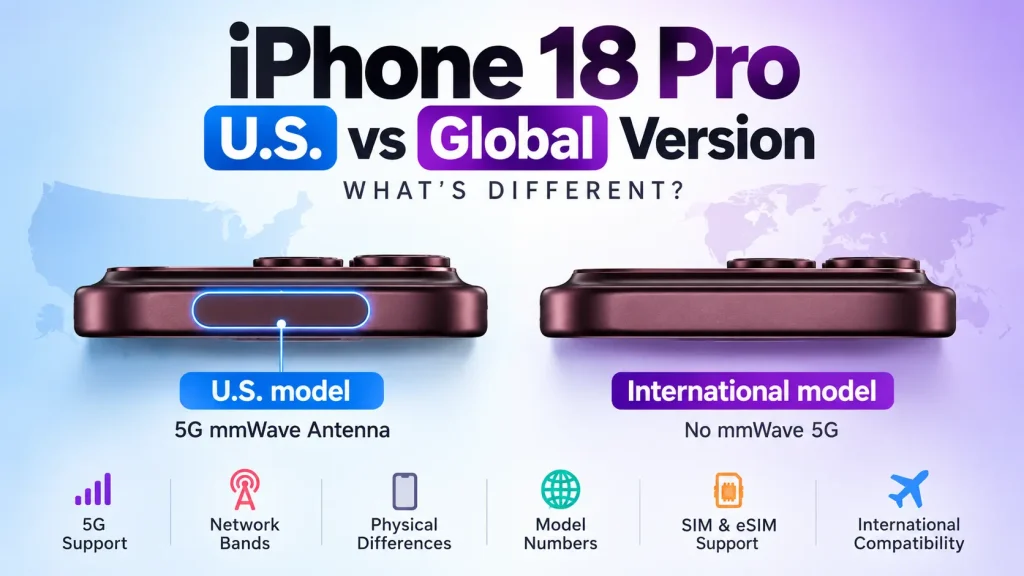
For the iPhone 18 Pro, Apple currently identifies several hardware model numbers:
- A3472 — United States and Puerto Rico
- A3713 — Japan, Guam, U.S. Virgin Islands, Canada, Mexico, Saudi Arabia, UAE, Oman, Kuwait, Bahrain, and Qatar
- A3714 — other countries and regions
- A3715 — mainland China
The iPhone 18 Pro Max has its own corresponding regional model numbers rather than using the Pro numbers.
That means the phrase “international iPhone 18 Pro” can be misleading. An iPhone sold in Saudi Arabia, for example, is not necessarily the same regional model as an iPhone sold in Europe or another country.
The biggest differences to understand are:
- 5G band support
- mmWave 5G
- Cellular hardware
- SIM configuration
- Physical design details associated with regional radio hardware
- Exact model number
- Carrier compatibility
U.S. vs Global iPhone 18 Pro at a Glance
| Feature | U.S. iPhone 18 Pro | International / other-region iPhone 18 Pro |
|---|---|---|
| Main U.S. model number | A3472 | A3714 for other countries/regions |
| Saudi Arabia model | Not the Saudi model | A3713 |
| Sub-6GHz 5G | Yes | Yes |
| mmWave 5G | Yes | Not listed for A3713/A3714 |
| mmWave bands | n258, n260, n261 | Not listed on A3713/A3714 |
| Physical SIM tray | No | Depends on region |
| Saudi Arabia SIM design | — | eSIM-only A3713 |
| Regional band differences | Yes | Yes |
| Exact compatibility | Depends on carrier | Depends on carrier and region |
| Model number important? | Yes | Yes |
Apple’s current specifications list mmWave bands n258, n260, and n261 for the U.S. A3472 model. Apple’s Saudi and international cellular tables do not list those mmWave bands for A3713 or A3714.
Why Does Apple Make Different iPhone 18 Pro Versions?
Cellular networks aren’t identical around the world.
Different countries and carriers use different combinations of:
- 4G LTE bands
- Sub-6GHz 5G bands
- mmWave 5G bands
- Network technologies
- SIM technologies
- Carrier certification requirements
Apple therefore creates regional hardware configurations that support the combinations required in different markets.
This doesn’t mean an international iPhone is a completely different phone.
The core iPhone 18 Pro platform remains the same, but the cellular configuration can differ.
That is why two iPhone 18 Pro units with the same storage capacity and appearance can have different model numbers and different radio capabilities.
What Is the U.S. iPhone 18 Pro Model Number?
The U.S. iPhone 18 Pro is model A3472.
Apple’s current model-identification documentation lists A3472 for the United States and Puerto Rico.
For the larger iPhone 18 Pro Max, the corresponding U.S. model is A3473.
This distinction is important when buying an imported device because a retailer may simply advertise a phone as:
iPhone 18 Pro 256GB
That description doesn’t tell you which regional hardware version you’re receiving.
If network compatibility matters, ask for the actual model number.
What Is the Global iPhone 18 Pro Model?
There isn’t one universal “global” model covering every country.
Apple identifies A3714 as the iPhone 18 Pro model for other countries and regions, while A3713 covers a specific group that includes Saudi Arabia and several other markets. Mainland China has A3715.
So when a retailer says “global version,” you should ask:
Which Apple model number is it?
For many markets, that will be A3714.
But if you’re buying a phone specifically for Saudi Arabia, the Apple-listed regional model is A3713, not A3714.
This is one of the most important points for international buyers.
What Is mmWave 5G?
mmWave is a form of 5G that uses very high-frequency radio spectrum.
It can deliver extremely high data rates, but the signals generally travel shorter distances and are more easily affected by physical obstacles than lower-frequency cellular signals.
Think of 5G as having different layers.
Sub-6GHz 5G
This uses frequencies below 6GHz.
It generally provides a better balance between:
- Coverage
- Range
- Speed
- Building penetration
It is the type of 5G most people encounter in ordinary mobile use.
mmWave 5G
mmWave uses much higher frequencies.
Its advantages can include:
- Very high peak speeds
- High capacity
- Useful performance in dense areas
But it has limitations:
- Shorter effective range
- More sensitivity to obstacles
- Greater dependence on network deployment
- Limited availability compared with mainstream sub-6GHz 5G
This is why having mmWave hardware doesn’t mean your phone will constantly use mmWave.
The carrier also needs to deploy compatible mmWave infrastructure where you’re using the phone.
Does the U.S. iPhone 18 Pro Have mmWave 5G?
Yes.
Apple’s current technical specifications list 5G NR mmWave bands n258, n260, and n261 for model A3472.
Apple also states that the new C2 cellular modem supports mmWave in the U.S. for the iPhone 18 Pro generation.
This is the most obvious cellular hardware difference between the U.S. configuration and the A3714/A3713 configurations.
Does the Global iPhone 18 Pro Have mmWave?
For the A3714 international model, Apple does not list the mmWave bands n258, n260, and n261 in its regional cellular specifications.
The same is true for the A3713 model used in Saudi Arabia and several other markets.
Those models list sub-6GHz 5G bands but not the U.S. mmWave bands.
So the practical distinction is:
U.S. A3472: sub-6GHz 5G + mmWave 5G.
Saudi A3713: sub-6GHz 5G, with no mmWave bands listed.
Other-region A3714: sub-6GHz 5G, with no mmWave bands listed.
That does not mean the international versions have weak 5G.
They support a broad range of conventional 5G bands.
What Are the iPhone 18 Pro 5G Bands?
The U.S. A3472 supports a broad list of sub-6GHz 5G bands plus mmWave.
Apple lists these FDD 5G bands:
- n1
- n2
- n3
- n5
- n7
- n8
- n12
- n14
- n20
- n25
- n26
- n28
- n29
- n30
- n66
- n70
- n71
- n75
It also lists TDD bands:
- n38
- n40
- n41
- n48
- n53
- n77
- n78
- n79
And U.S. A3472 additionally supports:
- n258
- n260
- n261
for mmWave 5G.
The important point is that the regional versions overlap heavily.
The difference isn’t that the U.S. phone has 5G while the global phone doesn’t.
The difference is which specific cellular bands and radio capabilities are built into each regional version.
What 5G Bands Does the Saudi iPhone 18 Pro Support?
Apple lists the Saudi-market iPhone 18 Pro as A3713.
Its listed 5G bands include:
- n1
- n2
- n3
- n5
- n7
- n8
- n12
- n14
- n20
- n25
- n26
- n28
- n29
- n30
- n66
- n70
- n71
- n75
- n38
- n40
- n41
- n48
- n53
- n77
- n78
- n79
Apple does not list n258, n260, or n261 for this model.
This makes the Saudi version a useful example of why “global” and “Saudi” should not automatically be treated as the same regional model.
What Is the Physical Difference Between U.S. and International Models?
The cellular hardware can create physical differences.
The U.S. version includes hardware for mmWave 5G, including a dedicated mmWave antenna configuration. Apple’s current repair documentation distinguishes logic-board configurations with and without a mmWave antenna.
Recent iPhone Pro generations have also used a visible antenna window associated with mmWave hardware.
However, buyers should not use the appearance of a small antenna window as the primary way to identify a regional iPhone.
The model number is much more reliable.
This is especially important because regional versions can share much of the same external design while differing internally.
The SIM tray is a more obvious physical difference
Apple’s current iPhone 18 Pro model-identification documentation says there is no physical SIM tray in:
- United States
- Puerto Rico
- Saudi Arabia
- Bahrain
- Canada
- Guam
- Japan
- Kuwait
- Mexico
- Oman
- Qatar
- UAE
- U.S. Virgin Islands
In other countries and regions, Apple lists a physical nano-SIM tray.
So the absence of a SIM tray does not uniquely identify a U.S. iPhone.
A Saudi iPhone 18 Pro is also eSIM-only.
Is the Saudi iPhone 18 Pro eSIM-Only?
Yes.
Apple specifically states that the iPhone 18 Pro and iPhone 18 Pro Max sold in Saudi Arabia use advanced eSIM technology and do not support physical SIM cards.
This is important when comparing a Saudi model with an iPhone imported from a country where Apple sells a physical-SIM configuration.
It also means that someone moving to Saudi Arabia with a foreign iPhone should check whether their particular model supports the eSIM setup required by their carrier.
U.S. iPhone 18 Pro vs Saudi iPhone 18 Pro
For a buyer in Saudi Arabia, the comparison is more useful than simply saying “U.S. vs global.”
| Feature | U.S. A3472 | Saudi A3713 |
|---|---|---|
| iPhone | 18 Pro | 18 Pro |
| Sub-6GHz 5G | Yes | Yes |
| mmWave 5G | Yes | Not listed |
| mmWave bands | n258/n260/n261 | Not listed |
| Physical SIM | No | No |
| eSIM | Yes | Yes |
| Regional 5G bands | U.S. configuration | Saudi/regional configuration |
| Model number | A3472 | A3713 |
| Saudi carrier compatibility | Must be checked | Must be checked |
| International roaming | Depends on carrier/bands | Depends on carrier/bands |
Apple lists A3713 specifically for Saudi Arabia and confirms that Saudi Arabia is part of the eSIM-only group.
Can a U.S. iPhone 18 Pro Work Internationally?
It can work internationally when the destination carrier uses bands supported by the U.S. model and the carrier allows the device to connect.
The U.S. model supports a broad collection of sub-6GHz bands in addition to mmWave.
That gives it substantial international network coverage potential.
But “works internationally” is not the same as:
“works with every carrier in every country.”
Carrier compatibility can depend on:
- Supported bands
- 4G fallback
- 5G deployment
- VoLTE
- Wi-Fi Calling
- eSIM availability
- Carrier certification
- Roaming agreements
- Network provisioning
Therefore, an unlocked U.S. iPhone should still be checked against the specific carrier you intend to use.
Can a Global iPhone 18 Pro Work in the United States?
It can connect to U.S. cellular networks where the model supports the required bands and the carrier accepts the device.
However, the international models do not provide the same mmWave capability listed for the U.S. A3472.
That means an A3714 or A3713 should not be described as having the same U.S. 5G capabilities as A3472.
For ordinary sub-6GHz 5G, the overlap is extensive.
For mmWave, the difference is significant.
What About U.S. Carriers?
Don’t assume compatibility solely because the phone says “iPhone 18 Pro.”
The exact regional model matters.
For example, the U.S. A3472 has a cellular-band configuration designed to include U.S. requirements and mmWave.
An imported A3714 can have a different band set.
If you’re buying an international iPhone for use in the United States, check the carrier’s current compatibility requirements before purchasing.
This is particularly important if you need:
- 5G
- 5G standalone features
- VoLTE
- Wi-Fi Calling
- eSIM activation
- Carrier-specific services
A phone can technically connect to a network while still lacking some carrier-specific features.
If you are checking whether a phone will work with a particular carrier, our guide to free phone carrier lookup explains how carrier information can be checked and what to know about mobile networks.
What About Saudi Carriers?
Saudi Arabia is an especially useful example because Apple assigns it to A3713, rather than the broader A3714 “other countries and regions” model.
Apple’s Saudi cellular specifications list a substantial selection of 5G and LTE bands for A3713.
But that does not mean every Saudi carrier uses every listed band.
Different operators can deploy different combinations of spectrum and technologies.
Therefore, before buying an imported iPhone for use in Saudi Arabia, compare:
Phone model → supported bands → carrier bands → SIM/eSIM requirements
rather than simply asking whether the phone is “international.”
Why Model Number Matters When Importing
The model number is the easiest way to move from vague regional labels to something specific.
A seller can call a device:
- International
- Global
- Middle East
- European
- Japanese
- U.S.
- Unlocked
But those labels don’t always tell you the exact hardware configuration.
Apple’s model numbers provide a much clearer starting point.
For the iPhone 18 Pro:
- A3472 = U.S./Puerto Rico
- A3713 = Japan, Guam, USVI, Canada, Mexico, Saudi Arabia, UAE, Oman, Kuwait, Bahrain, Qatar
- A3714 = other countries and regions
- A3715 = mainland China
For the iPhone 18 Pro Max:
- A3473 = U.S./Puerto Rico
- A3716 = Japan, Guam, USVI, Canada, Mexico, Saudi Arabia, UAE, Oman, Kuwait, Bahrain, Qatar
- A3717 = other countries and regions
- A3718 = mainland China
How to Identify Your iPhone 18 Pro Regional Version
If you already own the phone, check the model number through the device settings.
Go to:
Settings → General → About
Look for the Model Number field.
The displayed identifier can initially include a longer part number. Tapping it reveals the hardware model number in Apple’s standard format, such as A3472 or A3713.
You can then compare that number with Apple’s current model-identification information.
This is more reliable than trying to identify the phone from its packaging alone.
Don’t Confuse Model Number With Part Number
Apple devices can have multiple identifiers.
A retailer may show something resembling a sales or part number, while Apple’s hardware model number begins with an A followed by four digits.
For regional hardware comparisons, the A-number is the important identifier.
For example:
A3472
is the hardware model number for the U.S. iPhone 18 Pro.
That is different from a retail part number such as one containing country-specific letters.
If you’re buying an imported device, ask the seller specifically for the A-number model.
What Should You Check Before Buying an Imported iPhone 18 Pro?
Before paying for an imported device, check these items.
1. Exact model number
Ask for the A-number.
Don’t settle for “global version.”
2. 5G bands
Compare the phone’s bands with those used by your carrier.
3. mmWave requirements
If you specifically need U.S. mmWave 5G, verify that you’re buying a model that supports it.
The U.S. A3472 lists n258, n260, and n261.
4. SIM configuration
Confirm whether the device is:
- eSIM-only
- Physical nano-SIM + eSIM
- Another regional configuration
This is particularly important when importing into Saudi Arabia or other eSIM-only markets.
5. Carrier activation
Ask the carrier whether the exact model can be activated and whether all relevant services are supported.
6. Warranty and service
Check the seller’s warranty and understand whether international service conditions differ.
7. Return policy
Imported devices can be harder to return if you discover a compatibility problem.
8. Regional restrictions
Some iPhone features can vary by country or regulatory environment.
Don’t assume every regional iPhone behaves identically in every market.
Does an Imported iPhone Have the Same Performance?
Regional cellular hardware differences do not automatically mean the phone has a different processor or completely different performance class.
The iPhone 18 Pro platform remains an iPhone 18 Pro.
The regional differences discussed here primarily concern connectivity, cellular hardware, SIM configuration, and associated regional requirements.
That is why an international model can still have the same core iPhone experience while supporting a different set of cellular capabilities.
iPhone 18 Pro vs iPhone 18 Pro Max: Don’t Mix the Model Numbers
This is an easy mistake to make when researching imported iPhones.
The iPhone 18 Pro and iPhone 18 Pro Max have separate model-number groups.
iPhone 18 Pro
- U.S.: A3472
- Saudi/regional group: A3713
- Other countries/regions: A3714
- Mainland China: A3715
iPhone 18 Pro Max
- U.S.: A3473
- Saudi/regional group: A3716
- Other countries/regions: A3717
- Mainland China: A3718
Apple’s current specifications also show that the two Pro models should not simply be treated as interchangeable when discussing cellular hardware. In particular, current reporting and Apple’s documentation show a modem-related regional distinction on the U.S. Pro Max that differs from the smaller Pro.
For an article focused specifically on the iPhone 18 Pro, the safest approach is therefore to verify the exact model rather than applying a Pro Max specification automatically.
Is the U.S. Version Better Than the Global Version?
There isn’t a universal answer.
The U.S. model has a capability that some international versions don’t: mmWave 5G support.
But whether that matters depends on where and how you use the phone.
Someone who regularly uses a carrier and location with mmWave deployment may care about that capability.
Someone using the phone primarily in Saudi Arabia, where the Apple-listed regional A3713 model focuses on sub-6GHz 5G, may have different priorities.
The relevant question is therefore not:
“Which version is better?”
It’s:
“Which regional configuration matches the networks and SIM requirements where I will use the phone?”
Common Mistakes When Buying an Imported iPhone 18 Pro
Mistake 1: Assuming “global” means one model
Apple has multiple international/regional model numbers.
Mistake 2: Looking only at 5G branding
Two phones can both say “5G” while supporting different bands.
Mistake 3: Assuming all international models have a physical SIM
Saudi Arabia and several other markets receive eSIM-only iPhone 18 Pro models.
Mistake 4: Assuming U.S. means incompatible overseas
The U.S. model supports many sub-6GHz bands used internationally.
Mistake 5: Assuming U.S. means every international network works
No regional model is guaranteed to support every carrier.
Mistake 6: Confusing Pro and Pro Max model numbers
A3472 is the U.S. Pro.
A3473 is the U.S. Pro Max.
Mistake 7: Trusting a retailer’s regional label
“International,” “global,” and “Middle East” are not substitutes for the exact Apple model number.
iPhone 18 Pro Regional Differences: The Simple Explanation
The easiest way to understand the situation is:
U.S. model
The A3472 adds mmWave 5G support alongside a broad sub-6GHz band set.
Saudi/regional model
The A3713 supports a broad sub-6GHz 5G configuration and is eSIM-only in Saudi Arabia, but Apple does not list the U.S. mmWave bands for it.
Other international model
The A3714 is Apple’s model for other countries and regions, with its own band configuration and physical-SIM availability depending on the market.
China model
The A3715 is a separate regional configuration and should be evaluated independently rather than being lumped into the generic “global” category.
Final Takeaway
The iPhone 18 Pro U.S. vs global version comparison comes down primarily to regional cellular hardware rather than a completely different phone.
The U.S. A3472 supports sub-6GHz 5G plus mmWave bands n258, n260, and n261.
The Saudi A3713 supports a broad sub-6GHz 5G configuration but does not list those mmWave bands.
Apple uses A3714 for other countries and regions, while mainland China has A3715.
The SIM configuration is another important difference. The U.S. and Saudi versions are eSIM-only, while Apple lists physical nano-SIM trays for iPhone 18 Pro models sold in other regions.
For international buyers, the safest method is therefore simple:
Check the exact model number → check the supported bands → check your carrier → check the SIM/eSIM requirement.
Don’t rely on a seller calling a phone “global” or “international.”
And don’t assume that the iPhone 18 Pro Max has exactly the same regional hardware as the smaller iPhone 18 Pro.
Questions About iPhone 18 Pro
Does the U.S. iPhone 18 Pro have a different 5G antenna?
Yes. The U.S. configuration includes hardware for mmWave 5G, and Apple’s repair documentation identifies a logic-board configuration with a mmWave antenna. The U.S. model also has a different radio configuration from models that do not support mmWave.
Will an iPhone 18 Pro bought in Saudi Arabia have mmWave?
The Saudi A3713 model does not list the mmWave bands n258, n260, or n261 in Apple’s current cellular specifications. It instead supports a broad range of sub-6GHz 5G bands.
Can I use an A3472 iPhone 18 Pro with a Saudi carrier?
Potentially, but you should verify the exact carrier’s current band and eSIM requirements before buying. The A3472 supports many international sub-6GHz bands, but compatibility should be checked against the actual carrier rather than assumed from the phone’s U.S. origin.
Which model number should I check on an imported iPhone 18 Pro?
Check the A-number in Settings → General → About. For the 18 Pro, the main regional numbers are A3472, A3713, A3714, and A3715. For the 18 Pro Max, they are A3473, A3716, A3717, and A3718.