Android vs iPhone: What’s the Difference?
The Android vs iPhone debate has been going on for years, but the biggest mistake is treating it as if there is one feature that makes one platform universally better.
Android and iPhone take different approaches to smartphones.
Android is an operating system used by many manufacturers, including Samsung, Google, Xiaomi, OnePlus, Motorola, and others. That creates a large range of devices with different designs, cameras, processors, prices, software interfaces, and features.
The iPhone is Apple’s smartphone platform, combining Apple’s hardware with iOS and services such as iCloud, FaceTime, Apple Pay, AirDrop, and the wider Apple ecosystem.
That fundamental difference explains many of the smaller differences users notice.
Android generally gives you more hardware choice and customization, while iPhone emphasizes tight integration between hardware, software, and Apple’s other devices.
Neither description tells you which phone you should buy. The right choice depends on what you value most.
Android vs iPhone: The Biggest Difference
The biggest difference between iPhone and Android is how the platforms are controlled and distributed.
Apple controls the iPhone hardware, iOS software, and major parts of the surrounding ecosystem.
Android is developed as a platform that can be used by multiple manufacturers. Individual manufacturers can add their own interfaces, applications, services, hardware features, and update policies.
This creates two very different experiences.
With an iPhone, moving from one generation to another usually means staying within Apple’s hardware and software environment.
With Android, changing manufacturers can dramatically change the experience even though the underlying operating system is still Android.
For example, a Samsung Galaxy and a Google Pixel are both Android phones, but their interfaces, cameras, settings, hardware designs, and additional software can be quite different.
That variety is one of Android’s defining characteristics.
Android vs iPhone: Hardware and Device Choice
Android has a much wider range of hardware.
You can find Android phones designed around:
- Low prices
- Large displays
- Compact designs
- Foldable screens
- Gaming
- Photography
- Long battery life
- Stylus input
- High refresh-rate displays
- Large amounts of storage
- Specialized camera systems
The iPhone lineup is more controlled because Apple designs and sells the hardware itself.
This gives Android users more choice when shopping for a phone.
It also means Android buyers need to compare more specifications.
Two Android phones can have completely different:
- Processors
- Displays
- Cameras
- Charging systems
- Battery capacities
- Software interfaces
- Update policies
- Build materials
With iPhone, the number of hardware choices is smaller, which can make the purchasing decision more straightforward.
Android has more price flexibility
One of the major practical differences is price range.
Android manufacturers produce phones across many price categories.
Someone who wants an inexpensive Android phone can choose from numerous models, while someone with a larger budget can buy a premium flagship.
The iPhone lineup generally occupies a narrower range of the smartphone market.
This does not mean an inexpensive Android phone provides the same experience as a premium iPhone. Hardware quality varies substantially between Android models.
It simply means Android gives buyers more opportunities to choose hardware according to their budget.
Android vs iPhone: Operating System and User Experience
Android and iOS are both mature mobile operating systems, but their interfaces have different philosophies.
Android generally gives manufacturers and users more flexibility.
iOS provides a more controlled environment where Apple determines much of the interface, system behavior, and interaction between hardware and software.
Android manufacturers can also customize the operating system.
Samsung, for example, adds its own software experience on top of Android, while Google’s Pixel phones provide a different interpretation of Android.
This means the phrase “Android experience” does not describe one completely identical interface.
The basic platform is shared, but the final experience can vary by manufacturer.
Android vs iPhone: Customization
Customization is one of the strongest reasons some people prefer Android.
Android phones can provide extensive options for changing:
- Home-screen layouts
- Widgets
- Default applications
- Launchers
- Icons
- Wallpapers
- Notifications
- System behavior
- File-management workflows
- App-opening preferences
The exact capabilities depend on the Android version and manufacturer.
iPhone also offers customization, including widgets, home-screen arrangements, lock-screen customization, and other personalization features.
However, Apple’s approach remains more controlled.
If customization is a major priority, Android generally offers more room to change the way the phone behaves and looks.
That is one of the strongest factual explanations behind searches such as 10 reasons why Android is better than iPhone.
Rather than saying Android is simply “better,” it is more accurate to say that Android gives users more control in several areas.
Android vs iPhone: Apps and Ecosystem
Both platforms have huge app ecosystems.
Most major services are available on both Android and iPhone, including:
- Social networks
- Streaming services
- Banking applications
- Productivity tools
- Games
- Navigation
- Shopping apps
- Communication platforms
- Photo and video applications
The difference becomes more noticeable when you look beyond individual apps.
Apple’s ecosystem is tightly connected to products such as:
- Mac
- iPad
- Apple Watch
- AirPods
- Apple TV
Features such as AirDrop, iCloud synchronization, Handoff, and continuity between Apple devices can make the ecosystem particularly convenient for people who already own several Apple products.
Android also has an ecosystem built around Google services and a wide range of manufacturers and connected devices.
Google’s services work across Android, Windows, ChromeOS, the web, and other platforms, while individual manufacturers also provide their own connected-device features.
The important question is therefore not simply “Which phone has better apps?”
It is:
Which ecosystem already matches the devices and services you use?
Android vs iPhone: Cameras and Photography
The camera comparison is more complicated than simply counting megapixels.
Modern flagship phones on both platforms can produce excellent photographs and videos.
Important factors include:
- Sensor size
- Lens selection
- Image processing
- HDR processing
- Night photography
- Portrait modes
- Optical stabilization
- Video stabilization
- Zoom quality
- Front-camera processing
- Camera application features
Android gives consumers access to many different camera philosophies because different manufacturers use different hardware and image-processing systems.
A Samsung phone may approach photography differently from a Google Pixel, and both can differ substantially from an iPhone.
The iPhone’s advantage for some users is consistency across its hardware and software.
Instead of comparing “Android camera vs iPhone camera” as if Android were one device, it makes more sense to compare a particular Android phone against a particular iPhone.
Android vs iPhone: Battery and Charging
Battery life depends heavily on the specific model.
Factors include:
- Battery capacity
- Processor efficiency
- Display technology
- Display brightness
- Refresh rate
- Cellular signal
- Background applications
- Software optimization
- Gaming
- Camera usage
- Temperature
Android includes phones with very large batteries, while iPhone models can achieve strong battery life through the interaction between Apple’s hardware and software.
Charging is another area where Android manufacturers offer considerable variety.
Some Android phones support very fast wired charging, while others prioritize wireless charging or different charging accessories.
iPhone also supports wired and wireless charging, with Apple’s charging ecosystem and accessory compatibility forming part of the overall experience.
There is no universal battery winner because battery behavior varies by model and usage.
Android vs iPhone: Security and Privacy
Security is often simplified into claims such as “iPhone is secure” or “Android is less secure.”
The reality is more nuanced.
Both platforms have extensive security systems.
Apple uses hardware-backed security technologies, secure boot mechanisms, app protections, encryption, and controlled software distribution. Apple describes security as something integrated across its hardware, operating system, and services.
Android also includes multiple security layers. Google Play Protect scans applications, Android provides permission controls, and Google provides security updates and additional protections against malware, scams, phishing, and theft.
The Android ecosystem is more varied, however.
Different manufacturers can provide different hardware, software, update schedules, and security features.
That means security should be evaluated at the device level, not simply by asking whether a phone is Android or iPhone.
Privacy is also a separate question
Security and privacy overlap, but they are not identical.
Security asks whether unauthorized people or software can compromise your device and data.
Privacy asks how information is collected, processed, shared, and used.
Both Apple and Google provide privacy controls, but their business models and ecosystem designs differ.
Users should therefore look at the specific privacy settings and services they intend to use rather than relying on a simple platform-wide label.
Android vs iPhone: Updates and Long-Term Support
Software updates are another important difference.
Apple controls both iPhone hardware and iOS, allowing it to distribute system updates directly to supported iPhones.
Apple’s security documentation emphasizes regular software updates and a secure update process.
Android is more complicated because Google develops Android while individual manufacturers produce phones using the platform.
Update support can therefore vary by:
- Manufacturer
- Model
- Region
- Carrier
- Hardware generation
- Type of update
Modern Android manufacturers have significantly expanded their support commitments, but buyers should still check the specific model rather than assuming every Android phone receives updates for the same amount of time.
Google also separates Android OS updates, security updates, Google Play system components, and manufacturer-specific updates.
For long-term ownership, checking the manufacturer’s published support period before buying is more useful than relying on a general Android vs iPhone rule.
Android vs iPhone vs Samsung
One common search is Android vs iPhone vs Samsung, but there is an important terminology issue.
Samsung is not a direct alternative to Android.
Samsung makes smartphones that predominantly use Android.
So the more accurate comparison is:
iPhone vs Samsung Galaxy vs other Android phones.
Samsung’s Galaxy devices use Android while adding Samsung’s own hardware, software, services, and ecosystem features.
This gives Samsung users many of the characteristics associated with Android, including hardware variety and customization, while also creating a distinct Samsung experience.
A Pixel phone, Samsung Galaxy phone, OnePlus phone, and Motorola phone may all run Android while feeling different in daily use.
That is why comparing iPhone against a specific Android manufacturer is usually more useful than comparing iPhone against “Android” as though Android were one product.
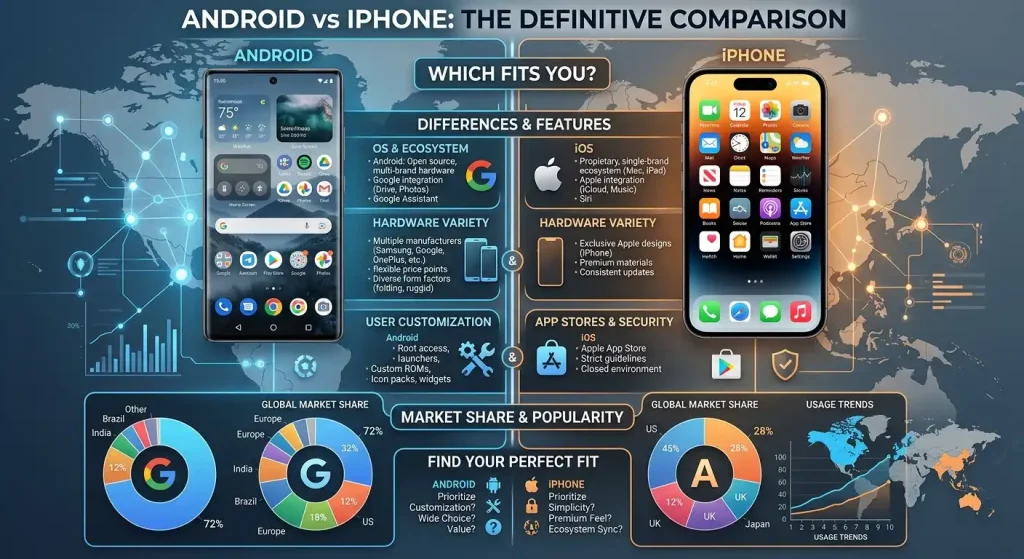
Android vs iPhone Market Share
The global market-share picture is one area where the difference between the platforms is measurable.
According to StatCounter’s worldwide mobile operating-system data for August 2026, Android accounted for about 67.6% of mobile operating-system usage, compared with about 32.4% for iOS.
These figures describe usage share, not the number of individual people who own each platform.
That distinction matters.
Market-share measurements can be influenced by:
- Web traffic
- Device usage
- Country
- Installed base
- Multiple devices
- Reporting methodology
Android’s larger worldwide share is also partly explained by the number of manufacturers and price categories using the platform.
The global market is not identical everywhere.
In some countries, iPhone has a much larger presence than the worldwide average, while Android dominates more strongly in other markets.
So “Android has more global users” does not mean Android is the majority platform in every country.
Android vs iPhone Users Worldwide
The phrase Android vs iPhone users worldwide often makes the comparison sound like two groups with completely different behavior.
In reality, smartphone users are not one uniform population.
People choose phones for different reasons:
- Price
- Camera quality
- Gaming
- Work
- Family ecosystem
- Brand preference
- Software features
- Device compatibility
- Local availability
- Carrier offers
- Accessories
- Existing devices
Someone who owns a MacBook and Apple Watch may place a high value on iPhone integration.
Someone who wants a foldable phone or a specific hardware feature may find more options in Android.
Someone buying a budget phone may have many more Android choices.
This is why worldwide market share tells you about the scale of each platform, but it does not tell you which platform is appropriate for an individual user.
Android vs iPhone for Gaming
Gaming performance should be evaluated by specific hardware rather than operating-system labels.
Both platforms have powerful phones capable of running demanding games.
Important factors include:
- Processor
- GPU
- Thermal management
- Display refresh rate
- Touch response
- Battery capacity
- Game optimization
- Storage
- Controller compatibility
Android offers a broad selection of gaming phones and high-refresh-rate devices.
iPhone benefits from Apple’s tightly controlled hardware and software environment, which can make performance characteristics relatively predictable across supported models.
Game availability can also vary between platforms and regions.
For serious mobile gaming, compare the exact phones and the games you actually play rather than assuming one operating system automatically wins.
Android vs iPhone for File Management
File handling is another area where Android and iPhone have historically taken different approaches.
Android generally provides a more computer-like approach to local files and storage.
Users can often interact with folders, downloaded files, removable storage on some devices, USB devices, and third-party file managers depending on the phone.
iPhone provides the Files app and supports local and cloud-based file management, but Apple’s overall system remains more controlled.
This difference matters more to some users than others.
If you regularly download files, move documents between devices, connect USB storage, or manage folders manually, the operating system’s file-management philosophy can have a noticeable impact.
Android vs iPhone for Accessories
Accessory compatibility depends on the specific phone, but Android’s manufacturer diversity creates a much larger range of device designs.
Cases, chargers, cables, mounts, watches, earbuds, gaming accessories, and other products can vary considerably between Android manufacturers.
The iPhone accessory market is also extremely large, but Apple’s smaller range of hardware designs makes compatibility easier to identify.
The important consideration is not simply how many accessories exist.
It is whether the accessories you already own or want to buy work with the particular phone.
10 Things Android Does Differently From iPhone
Instead of presenting these as ten reasons Android is objectively better, here are ten areas where Android commonly takes a different approach:
- More manufacturers — Android phones come from many companies.
- More hardware variety — Foldables, gaming phones, stylus devices, compact phones, and other designs are available.
- Broader price range — Android covers more price categories.
- More customization — Many Android devices provide extensive interface and system customization.
- Different manufacturer interfaces — Samsung, Google, OnePlus, Motorola, and others can provide different Android experiences.
- More flexible file workflows — Android often gives users more direct control over local files.
- More hardware-specific features — Manufacturers can differentiate their phones through cameras, displays, charging, and other technologies.
- Greater choice of default applications and system behavior — Android can provide more flexibility depending on the manufacturer and version.
- More form factors — Android has become a major platform for foldable and unconventional phone designs.
- A wider selection of devices connected to the platform — Android works across products from many manufacturers.
Whether these are advantages depends on what the individual user actually wants.
What About “Android vs iPhone Reddit”?
Reddit discussions can be useful for understanding how real users describe their experiences, but they should not be treated as scientific evidence.
Common Android vs iPhone discussion themes include:
- Customization
- Battery life
- Camera quality
- Messaging
- Notifications
- File management
- Ecosystem integration
- Repairability
- App quality
- Gaming
- Pricing
- Accessories
You will also find users who switched from Android to iPhone and others who switched from iPhone to Android.
These stories are valuable for identifying things that may matter in everyday use.
However, a Reddit user’s experience with one Samsung, Pixel, Xiaomi, or iPhone model cannot automatically be generalized to every device on the platform.
The useful question is:
What specific experience is the person describing, and does it apply to the device you are considering?
Android vs iPhone Memes and Online Culture
The Android vs iPhone meme culture is almost as old as the smartphone rivalry itself.
Online jokes commonly exaggerate differences involving:
- Phone prices
- Camera quality
- Green and blue messages
- Customization
- Charging
- Brand loyalty
- Status
- Accessories
- Software updates
- Phone design
Memes can be entertaining because they turn genuine differences into simple jokes.
But they are not a reliable way to compare phones.
For example, saying “Android users can customize everything” is an exaggeration. Saying “iPhones cannot be customized” is also an exaggeration.
The reality is somewhere in between, and it changes as both operating systems evolve.
Android vs iPhone: Which Is Better?
There is no single answer that applies to every user.
A better approach is to identify what matters most.
Android may fit you better if you prioritize:
- Broad hardware choice
- Different price levels
- Extensive customization
- Foldable phones
- Gaming-focused devices
- Manufacturer-specific features
- Flexible file management
- A particular Android manufacturer or Google service
iPhone may fit you better if you prioritize:
- Apple’s device ecosystem
- Integration with Mac and iPad
- Apple’s approach to software updates
- A controlled hardware/software experience
- Apple-specific services and accessories
- Consistent iOS behavior across supported iPhones
These are not absolute rules.
A person can prefer Android for one reason and iPhone for another.
Android vs iPhone: A Quick Comparison
| Category | Android | iPhone |
|---|---|---|
| Manufacturers | Many | Apple |
| Hardware choice | Very broad | More controlled |
| Price range | Very broad | More limited |
| Customization | Generally extensive | More controlled |
| Foldables | Multiple options | Not broadly represented in the traditional iPhone lineup |
| Ecosystem | Google + manufacturer ecosystems | Apple ecosystem |
| File management | Generally more flexible | More controlled |
| Software updates | Varies by manufacturer/model | Controlled by Apple |
| Security | Multiple platform and manufacturer protections | Apple-controlled hardware/software security |
| Camera experience | Highly varied by manufacturer | More consistent across Apple’s lineup |
| Gaming | Wide range of devices | Strong performance on supported models |
| Global usage | Larger worldwide share | Smaller worldwide share |
| Device choice | Very broad | Narrower |
The table describes platform characteristics rather than declaring a universal winner.
How to Choose Between Android and iPhone
If you are currently deciding between the two, start with your existing devices.
Choose based on your ecosystem
Already own a Mac, iPad, Apple Watch, or several Apple accessories?
The iPhone ecosystem may be an important factor.
Already use Google services heavily or prefer Windows and cross-platform tools?
Android may provide a more natural fit, depending on the specific device.
Choose based on hardware
Do not compare Android and iPhone only by operating system.
Compare actual models.
Look at:
- Display
- Camera
- Battery
- Processor
- Storage
- Charging
- Size
- Weight
- Durability
- Update support
- Price
A premium Android phone can have very different hardware from an inexpensive Android phone.
The same principle applies when comparing different iPhone generations.
Choose based on how much control you want
If you like changing the interface, experimenting with different hardware, managing files, and choosing between manufacturers, Android offers considerable flexibility.
If you prefer a more controlled experience with Apple’s hardware and services working together, iPhone may better match that preference.
Android vs iPhone: The Bottom Line
The Android vs iPhone comparison is really a comparison between two different approaches to smartphones.
Android emphasizes choice, manufacturer diversity, hardware variety, and customization.
iPhone emphasizes Apple-controlled hardware, iOS integration, and a tightly connected device ecosystem.
Android currently has the larger worldwide mobile operating-system share, with StatCounter reporting roughly two-thirds of global mobile OS usage for Android in August 2026.
But market share does not determine which phone is right for an individual.
The most useful comparison is therefore not “Which platform wins?”
It is:
Which platform’s hardware, software, ecosystem, customization, support, and everyday workflow match the way you actually use your phone?
That question produces a much more useful answer than a generic Android-versus-iPhone argument.
FAQs
Can you switch from Android to iPhone or iPhone to Android?
Yes. Both platforms provide migration tools for transferring many common types of information, although the exact process and what can be transferred varies depending on the services and devices involved.
Does Android have more phone choices than iPhone?
Yes. Android is used by many manufacturers, so buyers can choose among substantially more hardware designs, price categories, and form factors.
Is Samsung Android or a separate smartphone platform?
Samsung’s Galaxy smartphones use Android, with Samsung’s own software experience and ecosystem layered on top. Samsung is therefore better understood as an Android manufacturer rather than a separate operating system competing directly with Android.
Does Android’s larger global market share mean more people prefer it?
Not necessarily. Market share measures usage or traffic according to the methodology of the measurement service. It does not directly measure personal preference, satisfaction, or the reasons people chose their phones.