 18 min read
Companies That Offer Digital Subscriptions: Examples and Online Services
Digital subscriptions have become one of the most common ways people pay for online products and services.
Instead of buying something once, customers pay monthly or annually for continued access to content, software, entertainment, storage, education, memberships, or other digital benefits.
You encounter the model when paying for a streaming service, subscribing to a newspaper, using premium software, storing files in the cloud, joining an online learning platform, or accessing a paid gaming service.
For businesses, subscriptions can create recurring revenue and a longer relationship with customers. For consumers, they can provide continuous access without requiring a large one-time purchase.
This guide looks at companies that offer digital subscriptions across different industries. Rather than simply ranking companies, it explains the different subscription models, gives real examples, examines digital subscription business ideas, and explains what to consider before buying or starting a subscription service.
It also covers New York Times digital subscription options and explains why its different products are a useful example of how a modern digital publisher can structure subscriptions.
What Are Digital Subscriptions?
A digital subscription is an arrangement where a customer makes recurring payments in exchange for continued access to a digital product, service, content library, or set of benefits.
The billing period is commonly:
- Monthly
- Annual
- Quarterly
- Another recurring interval
The customer normally keeps access while the subscription remains active.
Unlike a traditional one-time purchase, the relationship continues over time.
For example, buying a software application outright may provide a permanent license to a particular version.
A software subscription may instead provide ongoing access to the application while also including updates, cloud features, support, or additional services.
The same principle applies to entertainment, publishing, education, cloud storage, and many other digital services.
Digital Subscription vs One-Time Purchase
Consider a movie.
With a traditional digital purchase, you might pay once for a particular title.
With a streaming subscription, you pay periodically for access to a much larger library.
The subscription therefore changes what the customer is purchasing.
Instead of owning or permanently purchasing one item, the customer is paying for continued access.
How Subscription-Based Businesses Work
A subscription business earns recurring revenue from customers who continue paying for access.
The basic cycle is:
Acquire → Subscribe → Use → Renew → Retain
A company first needs to attract a customer.
The customer then chooses a subscription plan.
The company provides the promised service.
If the customer continues to find value in it, the subscription renews.
This makes retention particularly important.
A company can acquire thousands of subscribers, but if customers cancel quickly, the business has to continually replace them.
Monthly vs Annual Subscriptions
Monthly plans usually provide a lower upfront commitment.
Annual plans require a larger payment but can provide a longer commitment.
Both approaches are common in digital services.
Some companies offer discounts for annual billing, while others focus primarily on monthly subscriptions.
Free and Paid Subscriptions
Not every subscription service starts with a payment.
Some companies use a freemium model.
The customer gets a basic service without paying and can upgrade to a premium subscription for additional features.
Spotify is a familiar example of this approach, combining a free, advertising-supported experience with paid plans.
Other services use free trials, limited free access, or occasional free content to introduce users to the paid product.
Types of Companies That Offer Digital Subscriptions
There is no single type of subscription business.
The model is used across many industries.
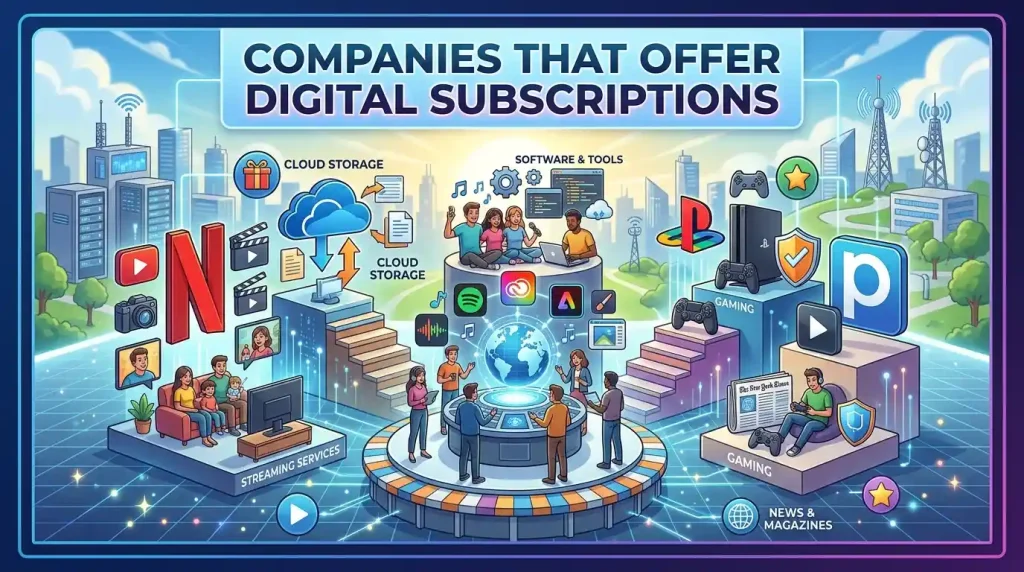
Streaming Companies
Video streaming is one of the most recognizable digital subscription categories.
Examples include:
- Netflix
- Disney+
- Max
- Hulu
- Paramount+
- Peacock
- Amazon Prime Video
Customers pay for access to a catalog of movies, television programs, original productions, or other video content.
Some services also offer advertising-supported plans alongside paid options.
Music and Audio
Music services use subscriptions to provide access to large catalogs.
Examples include:
- Spotify
- Apple Music
- YouTube Music
- Amazon Music
Rather than purchasing individual songs, subscribers receive continuing access to a music library while their subscription remains active.
Audio subscriptions can also include podcasts, audiobooks, radio programming, or other forms of spoken content.
News and Publishing
Digital publishing is another major subscription category.
Newspapers and publishers can use paywalls and subscription plans to turn regular readers into paying customers.
Examples include:
- The New York Times
- The Wall Street Journal
- The Washington Post
- Financial Times
The exact access model differs by publisher.
Some offer unlimited access after subscribing, while others combine free articles with limits before requiring a subscription.
Software and Productivity
Software-as-a-service is one of the most important digital subscription models.
Examples include:
- Adobe Creative Cloud
- Microsoft 365
- Canva
- Dropbox
- Notion
- Salesforce
- HubSpot
Customers pay for continuing access to software and related services.
Business software frequently uses tiered pricing, where the cost increases depending on features, users, storage, or usage.
Cloud Storage
Cloud storage companies offer recurring access to remote storage and related services.
Examples include:
- Google One
- Microsoft OneDrive
- Dropbox
- iCloud+
A user might subscribe because the free storage allocation is no longer sufficient.
The subscription can then provide additional storage and, depending on the service, other bundled benefits.
Gaming
Gaming subscriptions can take several forms.
Some provide access to game libraries.
Others provide online multiplayer access, discounts, cloud gaming, downloadable games, or additional benefits.
Examples include:
- Xbox Game Pass
- PlayStation Plus
- Nintendo Switch Online
- EA Play
The contents and benefits of these services can change over time, so subscribers should check the current plan before purchasing.
Education
Education companies can use subscriptions to provide continuing access to:
- Courses
- Tutorials
- Practice questions
- Certifications
- Learning libraries
- Language lessons
- Professional training
Examples include platforms such as:
- Coursera
- LinkedIn Learning
- Skillshare
- Duolingo
Some education businesses use subscriptions as their main revenue model, while others combine subscriptions with individual course purchases.
Fitness and Digital Wellness
Fitness has also moved into subscription-based digital services.
Examples include:
- Workout applications
- Meditation applications
- Digital coaching platforms
- Online fitness libraries
- Connected fitness services
The customer is usually paying for ongoing access to workouts, programs, coaching, tracking, or a content library.
Subscription-Based Business Examples
Looking at actual companies makes the model easier to understand.
| Company or service type | Subscription value |
|---|---|
| Netflix | Access to video entertainment |
| Spotify | Music and audio access |
| Adobe Creative Cloud | Professional creative software |
| Microsoft 365 | Productivity applications and cloud services |
| Google One | Cloud storage and additional benefits |
| Xbox Game Pass | Game access and related gaming benefits |
| The New York Times | News and digital media products |
| Canva | Premium design tools and content |
| Duolingo | Premium language-learning features |
| Dropbox | Cloud storage and collaboration |
These businesses do not all use exactly the same pricing model.
Some use tiers.
Some combine free and paid access.
Some charge according to users or usage.
Others primarily sell access to a content library.
That difference is important when studying subscription businesses.
List of Online Subscription Services
There are thousands of online subscription services, but they can be organized into useful categories.
Entertainment
- Netflix
- Disney+
- Max
- Hulu
- Paramount+
- Peacock
Music
- Spotify
- Apple Music
- YouTube Music
- Amazon Music
Software
- Adobe Creative Cloud
- Microsoft 365
- Canva
- Notion
- Salesforce
Cloud Storage
- Google One
- Dropbox
- OneDrive
- iCloud+
News and Publishing
- The New York Times
- The Wall Street Journal
- Financial Times
- The Washington Post
Gaming
- Xbox Game Pass
- PlayStation Plus
- Nintendo Switch Online
- EA Play
Education
- Coursera
- Skillshare
- LinkedIn Learning
- Duolingo
Creator and Community Services
Subscription-based creator platforms allow users to pay for access to exclusive content, communities, memberships, or other benefits.
This model can be used by:
- Writers
- Video creators
- Podcasters
- Artists
- Educators
- Industry experts
The subscription model is therefore not restricted to large technology companies.
A small creator can also build a subscription business around a highly specific audience.
Different Subscription Business Models
The word “subscription” describes the billing relationship, but businesses can structure what they sell in different ways.
Access Model
Customers pay for ongoing access to a service.
Streaming services are a straightforward example.
The value comes from continued access to a library or platform.
Freemium Model
A basic product is free while advanced features require payment.
This model reduces the barrier to trying the service.
The challenge is deciding which features belong in the free version and which justify upgrading.
Tiered Model
A company offers multiple subscription levels.
For example:
- Basic
- Standard
- Premium
- Business
Each level provides a different combination of features or usage limits.
Per-User Model
This is common in business software.
The customer pays according to the number of users or seats.
A company with 10 employees may therefore pay less than a company with 100 employees using the same software.
Usage-Based Model
The customer pays according to consumption.
This can work for services such as cloud computing, storage, API usage, or other digital infrastructure.
Hybrid Model
A company can combine several models.
For example, it might offer:
- Free access
- Paid subscription
- Additional usage charges
- One-time purchases
Hybrid models allow companies to serve different customer types but can also make pricing more complicated.
Digital Subscription Business Ideas
If you’re researching digital subscription business ideas, the first question should not be “What can I charge monthly?”
The better question is:
What problem can I solve repeatedly?
A subscription works best when customers have an ongoing reason to continue using the service.
Here are some digital subscription concepts.
Niche Research Library
Create a continuously updated database around a specific subject.
Possible examples include:
- Industry research
- Product databases
- Market information
- Professional resources
- Specialized reference material
The challenge is keeping the information valuable enough to justify continued payment.
Premium Newsletter
A specialized newsletter can provide:
- Industry analysis
- Curated information
- Research
- Market updates
- Expert commentary
A narrow subject can sometimes work better than trying to cover everything.
Software-as-a-Service Tool
A small online tool can use subscriptions when customers repeatedly need it.
Examples could include:
- Business calculators
- Reporting tools
- Monitoring systems
- Productivity tools
- Specialized generators
- Workflow automation
The key is recurring utility.
Digital Learning Membership
Instead of selling one course, a business can provide an expanding library of lessons and resources.
This can work for:
- Languages
- Professional skills
- Software training
- Exam preparation
- Hobbies
Premium Community
A paid community can provide:
- Discussions
- Resources
- Events
- Expert sessions
- Networking
- Member-only content
The community itself becomes part of the product.
Design or Creative Subscription
Businesses can sell recurring access to creative services rather than individual projects.
For example, a customer might pay a monthly fee for a defined level of:
- Graphic design
- Video editing
- Content creation
- Presentation design
The service needs clear limits and delivery expectations to remain manageable.
How Digital Subscription Businesses Make Money
Recurring billing is only the beginning.
A subscription business normally thinks about several financial variables.
Monthly Recurring Revenue
Monthly recurring revenue, commonly abbreviated as MRR, measures recurring subscription revenue on a monthly basis.
It helps businesses understand the recurring portion of their revenue.
Annual Recurring Revenue
ARR extends the same concept across a year.
It is often used in SaaS and other recurring-revenue businesses.
Churn
Churn measures customers who cancel or otherwise stop being subscribers during a period.
A high churn rate can make growth difficult even when new customers are constantly being acquired.
Customer Lifetime Value
Customer lifetime value estimates the revenue or contribution associated with a customer throughout the relationship.
Longer retention can increase lifetime value, assuming the subscription remains economically viable.
Acquisition Cost
Businesses also need to consider how much it costs to acquire a subscriber.
If acquiring a customer costs more than the value generated by that customer, the subscription model has a fundamental economic problem.
Subscription-Based Businesses for Sale
The search subscription-based businesses for sale usually means the person is looking for an existing business that already has recurring customers.
This is different from simply starting a new subscription business.
A buyer may be interested in:
- SaaS businesses
- Membership websites
- Subscription newsletters
- Digital communities
- Subscription ecommerce companies
- Online education businesses
- Content businesses
The recurring revenue can make these businesses attractive to buyers, but recurring revenue alone does not guarantee that a business is healthy.
What to Check Before Buying One
If you’re evaluating a subscription business for sale, examine:
- Monthly recurring revenue
- Annual recurring revenue
- Churn
- Customer concentration
- Customer acquisition cost
- Lifetime value
- Profit margins
- Refund rates
- Subscriber growth
- Traffic sources
- Product dependency
- Founder involvement
- Technology costs
- Contract terms
Also investigate whether subscribers remain active because they genuinely use the service or because of temporary discounts.
A business with impressive revenue but rapidly increasing cancellations may require a very different valuation from a business with stable retention.
New York Times Digital Subscription Options
The New York Times provides a useful example of how a large digital publisher can build several subscription products around the same overall brand.
Its current digital subscription structure includes All Access, along with standalone products such as:
- News
- Games
- Cooking
- Audio
- Wirecutter
- The Athletic
The current All Access offering combines News with Games, Cooking, Audio, Wirecutter, and The Athletic.
The New York Times also offers family subscription options for certain products.
This illustrates an important development in digital subscriptions:
A company does not necessarily have to sell only one subscription.
It can create individual products for specialized audiences and then create a broader bundle for customers who want several services.
What Is Included in NYTimes All Access?
The current All Access structure includes access to:
- News
- Games
- Cooking
- Audio
- Wirecutter
- The Athletic
That makes All Access different from a standalone Games or Cooking subscription.
For example, someone primarily interested in crossword puzzles may not need the same subscription as someone who wants the entire New York Times digital ecosystem.
NYTimes Games Subscription
The Games product focuses on the newspaper’s games and puzzles.
It includes access to games such as:
- The Crossword
- Wordle
- Spelling Bee
- Connections
- Strands
- Sudoku
- Tiles
- Other supported games and puzzle archives
The Games subscription does not automatically include News, Cooking, Wirecutter, Audio, or The Athletic.
This is an example of a standalone digital subscription.
NYTimes Cooking Subscription
Cooking provides access to the New York Times recipe database and related cooking tools.
It is aimed at users whose primary interest is food rather than general news.
Again, it is separate from the broader All Access bundle.
NYTimes Audio
The Audio subscription focuses on podcasts and audio journalism.
This demonstrates another subscription strategy: packaging a specific type of media consumption as its own product.
NYTimes Wirecutter
Wirecutter provides product recommendations and reviews.
It can be purchased as a standalone subscription or accessed through qualifying broader subscriptions.
NYTimes The Athletic
The Athletic provides sports journalism and related features.
Its inclusion in All Access demonstrates how a subscription bundle can combine several different content categories.
NYTimes Digital Subscription Cost
The NYTimes digital subscription cost is not one fixed number for every customer.
Pricing can vary based on:
- Subscription type
- Promotional offer
- Billing period
- Existing subscriber status
- Region
- Family plan
- Product selected
Current promotional offers can also be significantly different from the standard renewal price.
For example, a promotional offer may provide a discounted introductory period before the subscription changes to its regular rate.
That means a search result showing a low introductory price should not automatically be treated as the normal long-term price.
How to Evaluate NYTimes Pricing
When comparing a New York Times subscription, look at three numbers:
1. Introductory price
What you pay during the promotional period.
2. Standard renewal price
What the subscription costs after the promotional period ends.
3. Billing frequency
Whether you are charged every four weeks, monthly, annually, or according to another billing arrangement.
This approach gives a much clearer picture of the actual cost.
Because subscription offers change, check the current checkout terms before purchasing rather than relying on an old price quoted in an article.
Why Companies Offer Digital Subscriptions
There are several reasons businesses choose subscriptions.
Predictable Revenue
Recurring customers make future revenue easier to estimate than purely one-time transactions.
Customer Retention
A subscription creates an ongoing relationship.
The company has an incentive to keep improving the service because the customer can cancel.
Continuous Product Development
Software companies can use subscription revenue to fund ongoing development, updates, infrastructure, and support.
Bundling
Companies can combine several products into a single subscription.
The New York Times is a good example of this approach.
Lower Upfront Cost
A monthly subscription can make a service easier to start using than a large one-time purchase.
However, customers should remember that many smaller recurring charges can add up substantially over time.
How to Choose a Digital Subscription
Before subscribing, ask what you actually need.
Identify the Main Benefit
Are you paying for:
- Entertainment?
- Software?
- Storage?
- News?
- Education?
- Gaming?
- Fitness?
- Professional tools?
If the primary benefit is unclear, the subscription may not be worthwhile for you.
Check the Plan Limits
Look for:
- Storage limits
- Device limits
- User limits
- Download restrictions
- Offline access
- Advertising
- Feature restrictions
A cheap plan can become expensive if it does not meet your requirements.
Compare Monthly and Annual Pricing
Calculate the total annual cost rather than looking only at the monthly number.
Check Renewal Pricing
This is particularly important for promotional subscriptions.
Know what the price becomes after the introductory period.
Check Cancellation Rules
Understand:
- When cancellation takes effect
- Whether refunds are available
- Whether access continues until the end of the billing period
- Whether promotional pricing affects cancellation
Managing Multiple Online Subscriptions
A household can easily accumulate a large number of subscriptions.
Streaming, cloud storage, software, gaming, news, music, and education services can all create recurring charges.
A simple subscription inventory can help.
| Service | Category | Billing | Cost | Renewal date | Needed? |
|---|---|---|---|---|---|
| Service A | Streaming | Monthly | — | — | Yes |
| Service B | Cloud storage | Annual | — | — | Yes |
| Service C | News | Monthly | — | — | Maybe |
| Service D | Software | Annual | — | — | Yes |
Review the list periodically.
Look for subscriptions that:
- You rarely use
- Duplicate another service
- Have moved from promotional to standard pricing
- Are no longer necessary
- Can be replaced by a cheaper plan
Avoid Subscription Overlap
You may not need three services offering essentially the same type of content.
For example, a household with multiple video subscriptions may find that several services contain overlapping libraries.
Rotating subscriptions can sometimes reduce unnecessary spending if a service is only needed for a particular show, event, or project.
Advantages and Disadvantages of Digital Subscriptions
Subscriptions can be convenient, but they are not automatically better than one-time purchases.
Advantages
- Lower upfront cost
- Continuous access
- Regular updates
- New content
- Cloud synchronization
- Ongoing support
- Flexible service tiers
- Access to large libraries
Disadvantages
- Recurring expenses
- Price increases
- Automatic renewal
- Promotional pricing ending
- Cancellation management
- Multiple overlapping services
- Losing access after cancellation
The right choice depends on how frequently you use the service and how much ongoing value it provides.
Are Subscription Businesses Good Business Ideas?
A subscription model can work well when the customer has a recurring need.
Good candidates often have one or more of these characteristics:
- The product is used regularly
- New content is added continuously
- The service solves an ongoing problem
- Customers benefit from updates
- Switching away is inconvenient because the service becomes part of a workflow
- The business can deliver recurring value efficiently
The opposite is also true.
A subscription can be a poor fit when customers only need the product once.
For example, a simple tool that solves a problem in five minutes may not naturally justify a monthly fee unless there is additional ongoing value.
The important question is therefore not:
“Can this product have a subscription?”
It is:
“Will customers still receive enough value next month to willingly pay again?”
Key Takeaways
Companies that offer digital subscriptions operate across almost every part of the online economy.
Common categories include:
- Streaming
- Music
- News
- Software
- Cloud storage
- Gaming
- Education
- Fitness
- Creator communities
- Digital memberships
The subscription model itself can also take different forms, including freemium, tiered, per-user, usage-based, access, and hybrid models.
For consumers, the most important factors are the actual value received, plan limitations, renewal pricing, billing frequency, and cancellation terms.
For entrepreneurs, the most important question is whether a product can deliver meaningful value repeatedly.
The New York Times demonstrates another important approach: a company can offer standalone digital products while also combining multiple services into a broader subscription bundle.
That makes digital subscriptions much more than a simple monthly payment.
They are a way of structuring an ongoing relationship between a company and its customers.
Many productivity tools run on subscriptions — our cloud based productivity apps guide compares the best types for individuals and teams.
FAQs
Can a company offer both free and paid subscription services?
Yes. A business can use a freemium model where basic functionality remains free while premium features, additional content, or higher usage limits require payment. This can help a company attract users before asking them to become paying subscribers.
What is the difference between a subscription and a membership?
The terms overlap, but they can emphasize different things. A subscription usually describes recurring payment for ongoing access, while a membership can emphasize belonging, benefits, community, or exclusive privileges. Many digital businesses effectively combine both concepts.
Why do subscription prices sometimes change after signing up?
A customer may initially receive an introductory promotion. Once that promotional period ends, the subscription can renew at its standard rate. Companies can also change their pricing over time, subject to their applicable terms and notice requirements.
Can a small business use a digital subscription model?
Yes. A subscription does not require a large company. Small businesses can build subscriptions around specialized software, newsletters, research, education, communities, digital services, or recurring professional support. The key requirement is having a reason for customers to continue paying.