 22 min read
The Unsent Project: What It Is, How It Works, and How to Search
If you have searched for The Unsent Project, you may have seen people talking about anonymous messages, searching names, color-coded posts, first loves, and messages that were written but never sent.
The idea is simple but emotionally unusual: people submit messages they never sent to someone, and those messages become part of a large online archive.
The project was started by artist Rora Blue in 2015 as an exploration of the relationship between love and color. Instead of simply collecting anonymous text, the project asks contributors to associate their message with a color connected to their first love.
Today, the official project describes the archive as containing more than 5 million messages. The messages can involve romantic partners, exes, friends, family members, pets, or other people depending on how the contributor interprets the idea of “first love.”
The project has also changed over the years. Its archive, submission system, and website experience have been updated, which can make older explanations of The Unsent Project confusing.
This guide explains what the project is, how its search works, what the colors represent, how submissions work, and why the current app listings should not automatically be assumed to be the original project.
What Is The Unsent Project?
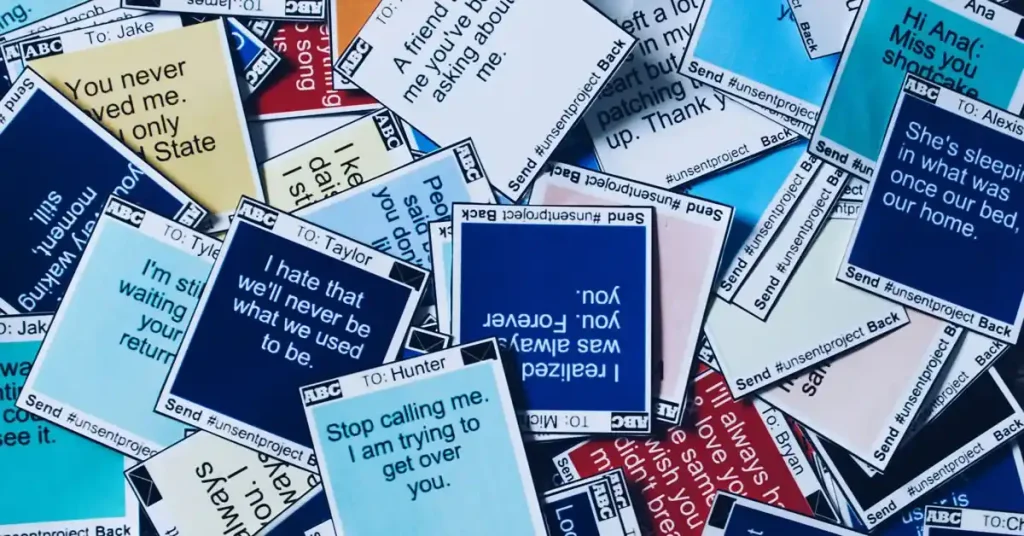
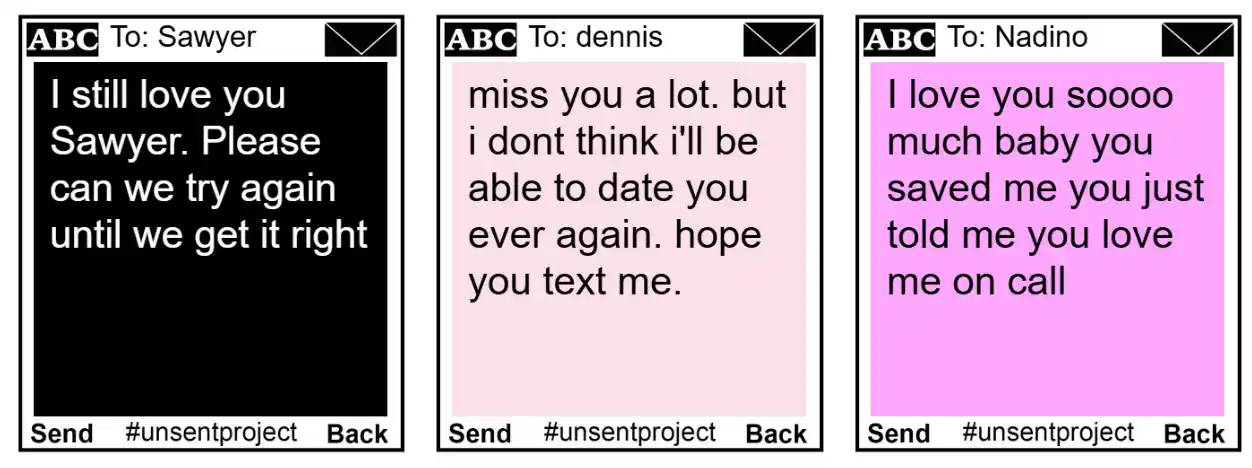
The Unsent Project is an online archive of anonymous messages that people never sent to someone else.
The project describes itself as a collection of unsent text messages to first loves. The concept began in 2015 when Rora Blue created the project to explore what color people associate with love.
When someone submits a message, they choose a color that represents their first love or the person to whom the message is connected.
The result is an archive where emotional messages appear alongside a particular color.
The messages cover a very broad range of experiences.
Some are romantic. Others are angry, nostalgic, apologetic, affectionate, sad, hopeful, regretful, or completely ordinary. The person described as a “first love” does not necessarily have to be a romantic partner.
The official project explains that submissions have been addressed to:
- Lovers
- Best friends
- Exes
- Parents
- Siblings
- Pets
- Other people who were emotionally significant to the contributor
That flexibility is part of what makes the archive different from a conventional collection of love letters.
The messages are not necessarily written to communicate something to the recipient. They are submitted because the writer never sent them and wants to place those words somewhere outside their own private thoughts.
Who Created The Unsent Project?
The Unsent Project was started by artist Rora Blue in 2015.
The original concept centered on a question about emotion and color: what color do people associate with love?
Rather than asking people to describe their feelings through a traditional survey, the project used unsent messages as the material.
Each contributor could connect their message with a color associated with the person they considered their first love.
That created both an emotional archive and a visual one.
Instead of seeing thousands of messages as plain black text on a white page, visitors encounter messages organized around different colors and emotional associations.
The project therefore sits somewhere between digital archive, participatory art project, and anonymous online expression.
How Does The Unsent Project Work?
The basic process is straightforward.
A contributor writes a message that they never sent to someone.
They provide the recipient’s first name and select a color associated with that person or relationship.
The submission then goes through the project’s rules and review process before potentially becoming part of the public archive.
Visitors can explore the resulting collection rather than communicate directly with the people who submitted the messages.
That distinction matters.
The Unsent Project is not designed as a messaging service.
You are not sending a message to another user through the archive. You are submitting or reading an anonymous piece of writing.
The project itself has also explicitly described the platform as something other than a chatroom or social media network.
A simple example
Imagine someone named Alex wrote this but never sent it:
I still think about the summer we spent together. I hope you’re doing well.
They could submit the message to the project and associate it with a particular color.
The message could then become part of the archive under the name Alex.
Someone browsing the archive could encounter it, but that does not mean the message was actually written by a particular Alex they know.
That distinction becomes especially important when searching for your own name.
How To Search The Unsent Project
The current archive provides a search function that allows visitors to look for messages associated with a name.
The process is generally:
- Open the official Unsent Project archive.
- Find the archive search field.
- Enter a name.
- Run the search.
- Browse any matching messages.
- Use available filtering options when applicable.
The archive is organized around the name associated with the submission rather than providing a conventional social-media profile for that person.
A search result should therefore be treated as an anonymous piece of user-submitted content, not as a verified message from someone you know.
Why searching a name can be misleading
Suppose your name is Sarah.
You search for “Sarah” and find several messages.
It is tempting to assume that one of those messages was written by a person who knows you.
There is no reliable basis for making that assumption.
A first name can belong to thousands or millions of people, and the project does not provide a mechanism for proving who the recipient actually was.
The archive is better understood as a collection of anonymous emotional writing than as a hidden inbox.
Can You Search The Unsent Project By Name?
Yes.
Searching by name is one of the central ways visitors explore the archive.
The official archive has a search field for entering a name, and indexed submissions can appear in the results.
However, finding your name does not establish that a message was written about you.
For example, finding:
Emily, I wish I had told you sooner.
does not prove that someone named Emily knows the writer or that the message refers to a particular Emily.
There may be countless people with the same name.
The search function is therefore useful for discovering messages associated with a name, but it should not be treated as an identity-verification tool.
What Do The Colors Mean?
Color is one of the defining features of The Unsent Project.
The original idea was based on exploring what color people see love in.
Instead of imposing a single universal interpretation on every color, the project allows the contributor’s association with their first love to determine the color attached to the message.
That means a color should not automatically be interpreted as having one fixed psychological meaning.
For example, one person might associate a particular shade with comfort while another might associate the same shade with sadness.
The color belongs to the contributor’s emotional association.
Why the color system matters
Without the color element, The Unsent Project could simply be a large collection of anonymous messages.
The colors turn the archive into a visual representation of emotion.
A visitor can encounter different messages grouped around colors and notice that similar emotional experiences can be represented in very different visual ways.
This is one of the reasons the project works as digital culture as well as an anonymous-message archive.
Are The Unsent Project colors universal?
Not necessarily.
It is better to think of the colors as personal associations rather than a universal color dictionary.
If a contributor chooses blue, that does not automatically mean the message represents sadness.
If another contributor chooses red, that does not automatically mean the message represents passion.
The original concept asks people what color they see love in, so the meaning comes from the individual’s relationship and interpretation.
How To Submit A Message To The Unsent Project
The current website provides a submission page where visitors can enter a recipient name and submit a message.
Before submitting, however, it is important to understand the project’s rules.
The current terms state that:
- You must be at least 18 to use the services.
- Submissions are reviewed before publication.
- There is a maximum of one submission in a 24-hour period.
- Submissions must be in English.
- Certain identifying information is prohibited.
- Duplicate submissions can be removed.
- Content violating the submission rules can be rejected.
The project specifically prohibits information such as addresses, phone numbers, last names, usernames, employment information, and other identifying details.
That makes sense for an archive built around anonymous expression.
What should you avoid putting in a submission?
Do not include information that could identify or expose another person.
For example, avoid:
- Full names
- Phone numbers
- Home addresses
- Social media usernames
- Workplace details
- Private identifying information
- Doxing information
- Threats
- Hate speech
- Harassment
- Bullying
- Defamatory accusations
- Explicit identifying details
A message can still communicate a powerful emotion without revealing someone’s identity.
Are The Unsent Project Messages Really Anonymous?
The project describes submissions as anonymous, but anonymous does not mean completely private.
This is an important distinction.
The public-facing message may not identify the person who submitted it. However, the project’s terms warn contributors that information entered into a submission can be seen and searched for by people on the internet indefinitely.
The terms also state that there is no way to delete an Unsent Project submission from the project or the internet.
That means contributors should think carefully before submitting anything.
Anonymous to readers does not mean risk-free
A message such as:
I still miss the person I met at school.
does not necessarily identify anyone.
But adding specific details could make the people involved recognizable.
For example, including a workplace, phone number, username, exact location, or other identifying information could undermine the anonymity of the message.
The safest approach is to keep submissions emotional rather than identifying.
Is The Unsent Project A Social Media Platform?
No, not in the conventional sense.
The project has specifically described itself as not a chatroom or social media platform.
There are no conventional friend lists, follower relationships, direct-message conversations, or public profiles that operate like mainstream social networks.
Its primary purpose is the collection and presentation of unsent messages.
You can read messages from other contributors, and you can submit your own, but that does not create a normal social relationship between users.
This distinction also explains why the project can feel like a social platform while technically functioning very differently.
It contains user-generated content and attracts a large audience, but the central interaction is with the archive rather than with other users.
Is There An Unsent Project App?
This is where things can become confusing.
There is currently an App Store listing using the name The Unsent Project, but the listing identifies Hamza Mihfad as its developer.
The listing describes itself as being inspired by the famous Unsent Project concept and offers features such as searching anonymous messages and searching by name.
That is different from simply saying that the original Rora Blue project has released an official iPhone app.
Original project vs similarly named app
When searching for “The Unsent Project app,” pay attention to the developer information.
The original project is associated with Rora Blue.
The App Store listing currently using the name “The Unsent Project” identifies Hamza Mihfad as the developer.
Therefore, users should not automatically assume that an app using the same name is the official mobile version of the original art project.
This is particularly important when an app asks for permissions, subscriptions, personal information, or payment.
Always check:
- Developer name
- App description
- Developer website
- Privacy information
- Terms
- Whether the developer clearly identifies its relationship to the original project
A similar name alone is not proof of an official connection.
The Unsent Project Website vs Third-Party Apps and Sites
The distinction becomes even more important because “unsent messages” is now a broader internet concept.
You may find:
- The original Unsent Project website
- Third-party apps inspired by the concept
- Unofficial archive references
- Social media posts discussing the project
- Videos explaining the project
- Websites using similar terminology
These should not all be treated as the same service.
The original project has its own website, archive, submission rules, and terms.
A third-party service may borrow the concept while operating under a completely different company or developer.
How to identify the original project
Look for consistency across the project’s own information.
The original project identifies itself as the Unsent Project and describes its origins with Rora Blue in 2015.
Its current site also provides its own archive and submission system.
If another service uses the name but identifies a different developer or organization, treat it as a separate service unless there is clear evidence of an official relationship.
Is The Unsent Project Legit?
The Unsent Project is a real online art and archive project that originated in 2015 and has an active website and archive.
Its current website identifies Rora Blue as the creator and describes millions of anonymous submissions.
There is also evidence of current archive activity, with individual submissions appearing on the project’s website in 2026.
However, “legitimate” does not mean that every message you read is true, accurate, or actually connected to the person named in it.
The project itself warns that user-generated content can be offensive, harmful, inaccurate, inappropriate, mislabeled, or deceptive.
That is an important distinction.
The archive is not a verification system
If you read:
I saw you yesterday and wanted to say something.
you have no reliable way to verify who wrote it, who it was about, or whether the story is completely accurate.
Anonymous archives naturally have limited context.
Treat the messages as expressions submitted by users, not as verified evidence about real-world relationships.
What Happened To The Old Unsent Project Archive?
The project has gone through changes to its website and archive.
According to the project’s published site update, submissions were reinstated with manual approval after a large number of entries violated submission guidelines.
The update also explained that submissions made before July 9, 2023 were temporarily inaccessible while non-compliant material was reviewed.
This helps explain why someone who used The Unsent Project in the past may remember an archive experience that looks different from the current website.
The project has continued to evolve rather than remaining identical to its earlier version.
Why older search results can be confusing
Search engines, social posts, videos, and articles may describe an older version of the project.
You might therefore encounter instructions referring to:
- An older archive design
- Older search behavior
- Different submission rules
- Previously accessible messages
- Older descriptions of the project
- Third-party apps or websites
When something conflicts with the current site, the current project’s own information should be treated as the more relevant reference for how the service currently works.
What Happens After You Submit A Message?
Submitting a message does not guarantee immediate publication.
The current terms explain that submissions are reviewed and that the project cannot guarantee that every submission will be reviewed or posted.
The published site update also explains that manual approval was introduced because many submissions violated the project’s rules.
This means a submission can be rejected even if the contributor successfully enters it into the submission form.
The review process is therefore an important part of the current experience.
Can You Delete An Unsent Project Message?
This is one of the most important things to understand before submitting.
The project’s terms state that there is no way to delete an Unsent Project submission from the project or the internet.
That makes submitting a message different from posting a normal social-media update that you expect to be able to remove later.
Before submitting, consider whether you are comfortable with the message potentially remaining publicly searchable.
If the answer is no, it is better not to submit it.
Is The Unsent Project Safe To Browse?
The project warns visitors that they may encounter explicit content before entering the site.
Its terms also explain that user-generated content can be offensive, harmful, inaccurate, inappropriate, mislabeled, or deceptive.
So the archive should be approached as an unmoderated or partially moderated collection of human submissions rather than a carefully edited publication.
That does not mean every message is problematic.
It simply means the content can vary substantially.
Some messages are affectionate.
Others are heartbreaking.
Some are angry.
Some are funny or strange.
Others may contain subjects that some readers find uncomfortable.
If you are sensitive to emotionally intense or adult user-generated content, keep that in mind before browsing.
What Makes The Unsent Project Different From A Normal Anonymous Confession Site?
The color system is probably the biggest difference.
Many anonymous confession websites focus primarily on the text.
The Unsent Project combines:
message + recipient name + emotional association + color
That creates a visual archive rather than just a chronological stream of confessions.
The project’s connection to first love also gives it a particular emotional theme.
At the same time, the definition of first love is intentionally broad.
A contributor does not necessarily have to be talking about a former boyfriend or girlfriend.
A first love could be interpreted as a friend, family member, pet, or another person who had a major emotional impact.
Why Do People Search Their Name On The Unsent Project?
There are several possible reasons.
Some people are simply curious.
Others have heard about the project on social media and want to see what messages appear under their name.
Some are interested in the emotional writing itself.
And some people hope to find a message from someone they once knew.
The last reason is where expectations need to be managed.
A name search cannot establish who wrote a message.
Finding your name in the archive is interesting, but it should not be interpreted as proof that someone you know submitted the message.
What Does “The Unsent Project By Name” Actually Mean?
When people search for “The Unsent Project by name,” they are generally referring to the archive’s ability to search messages associated with a recipient name.
The search is not equivalent to searching a person’s profile.
There is no guarantee that the person named in a message is the person you think it is.
For example, a search for “Michael” may return messages submitted for many different people named Michael.
The archive does not provide enough context to connect each message to a particular real-world person.
Think of the search as finding messages associated with a name, not finding private messages secretly written about you.
The Unsent Project And Reddit
Reddit discussions can help explain why people are curious about The Unsent Project, particularly when users share personal experiences with searching the archive.
However, Reddit posts are anecdotal.
A Reddit user saying that they found a message matching their relationship does not prove that the message was actually written by the person they suspected.
Likewise, claims about how the project works may refer to an older version of the website.
For factual questions about the current archive, submission rules, age requirements, and privacy terms, the project’s current website is a more appropriate reference.
Reddit is better treated as a source of user experiences and discussion rather than authoritative documentation.
What To Know Before Reading Or Submitting Messages
The Unsent Project can be fascinating, but it is worth understanding what you are actually interacting with.
1. The messages are user submissions
They are not professionally verified stories.
2. A name does not prove identity
A message attached to your name does not necessarily have anything to do with you.
3. The content can be emotional
You may encounter grief, anger, regret, love, jealousy, heartbreak, or other intense emotions.
4. The project has age restrictions
The current site and terms state that users must be at least 18.
5. Submissions may remain online
The terms warn that submitted information can be searchable indefinitely.
6. You should not submit identifying information
Do not use the project as a place to expose someone’s private details.
7. Submission does not guarantee publication
Messages are subject to review and the project does not guarantee every submission will be posted.
8. Third-party apps are separate questions
If you find an app using the Unsent Project name, check who developed it before assuming it is connected to the original project.
Why The Unsent Project Matters As Digital Culture
The project is interesting beyond its search functionality.
It reflects a broader internet habit: people use digital spaces to express thoughts that they would not necessarily communicate directly.
Traditional letters can remain private.
Text messages are normally sent to a specific recipient.
Social-media posts are generally written for an audience.
The Unsent Project occupies a different space.
The writer creates something addressed to another person but deliberately leaves it unsent.
The archive then turns that private act into a public piece of anonymous digital expression.
That creates an unusual relationship between privacy and publication.
The original message was never sent to its intended recipient, yet it can eventually be read by strangers.
That tension is a major part of what makes the project culturally interesting.
The Unsent Project In One Sentence
The Unsent Project is an anonymous digital archive of messages people never sent, organized around names and colors and originally created by Rora Blue in 2015 to explore the relationship between love and color.
The project has grown into a large collection containing millions of submissions, while its current website includes search and submission features governed by specific content and privacy rules.
If you want to explore it, the most useful thing to remember is that the archive is a collection of anonymous expressions—not a hidden messaging system or a reliable way to identify who wrote something about a particular person.
Key Takeaways
- The Unsent Project began in 2015.
- It was created by artist Rora Blue.
- The project focuses on messages that people never sent to their first loves.
- The definition of “first love” is broad and can include friends, family, pets, exes, and other meaningful relationships.
- The current project describes its archive as containing more than 5 million messages.
- Messages are associated with colors chosen by contributors.
- The colors should be understood as personal emotional associations rather than a universal color-code system.
- The archive can be searched by name.
- A matching name does not prove that a message was written about you.
- The project is not a conventional social network or chatroom.
- The current site requires users to be at least 18.
- Submissions are subject to review and content rules.
- The project’s terms warn that submitted information can remain searchable indefinitely.
- The terms state that submissions cannot be deleted from the project or internet.
- The website and archive have changed over time.
- There is currently an App Store listing using the name “The Unsent Project,” but it identifies Hamza Mihfad as the developer, so it should not automatically be treated as the original Rora Blue project.
- Third-party discussions, including Reddit posts, should be treated as user experiences rather than authoritative documentation.
The Unsent Project isn’t the only app built around private sharing — our Locket app guide explains how its close-friends photo widget works.
Google Doodles are another corner of internet culture — you can play classic Google Doodle games like Champion Island and PAC-MAN for free.
Can You See Unsent Messages on iPhone?
The quick answer: No — once someone unsends an iMessage on iPhone, you cannot see its content through any built-in iPhone feature. The message disappears from the conversation and is replaced with a notice saying the sender unsent a message. Any app claiming to recover unsent iMessages should not be trusted.
Apple added the Unsend feature in iOS 16. It works like this:
- The sender has 2 minutes after sending to unsend a message (tap and hold the message, then tap Undo Send).
- Both the sender and the recipient must be on iOS 16 or later; otherwise unsend may not work cleanly.
- After unsending, both sides see “[Name] unsent a message” — the original text is gone from the thread.
- If you saw a lock-screen notification preview before it was unsent, that preview text may still be visible in your notification history until it is cleared — this is the only case where part of an unsent message can still be seen, and it only works if you happened to see the notification first.
- There is no Recycle Bin or Recently Deleted folder for unsent iMessages. Unlike deleted photos, unsent messages cannot be recovered from the device.
Be cautious with third-party apps that promise to reveal unsent messages. They typically require invasive access to your notifications or Apple ID and are a common source of scams and data theft — which is exactly why they are not worth the risk.
FAQs
Can someone know if I searched their name on The Unsent Project?
A name search is an archive-search action, not a social-media interaction with the person whose name you entered. The project does not function like a profile-view notification system.
Why can’t I find an old message that I remember seeing?
The archive has changed over time, and the project has previously made older submissions temporarily inaccessible while reviewing content. An older message may therefore not appear in the current archive in the same way it did previously.
Does choosing a color reveal exactly how someone felt?
No. The color represents the contributor’s association with the person or relationship. It should not be treated as a universal emotional code where every color has one fixed meaning.
Can I use a full name when submitting a message?
The project’s submission rules prohibit identifying information, including last names and several other forms of personal information. A submission should avoid details that could expose or identify another person.
Can I read a message after someone unsends it oessage is unsent, its content is removed from the conversation on both devices. The only exception is a notification preview you may have seen on your lock screen before it was unsent.
Can I read a message after someone unsends it on iPhone?
No. Once a message is unsent, its content is removed from the conversation on both devices. The only exception is a notification preview you may have seen on your lock screen before it was unsent.
Does the other person know if I unsend a message?
Yes. Both sides see a notice that a message was unsent, though the original content is not shown.